

Structure vs Control: A Boundary Many People Miss
When supportive routines quietly become something more rigid
Much of the advice around wellbeing points to the importance of structure; Regular meals. Consistent routines. Clear boundaries.
And for good reason.
Structure can be deeply stabilising. It reduces unnecessary decision-making, supports emotional regulation, and creates a sense of steadiness when things feel unsettled.
For many people, introducing structure is an important step towards feeling more balanced. But over time, something more subtle can happen.
Structure can quietly shift into control.
And when it does, it begins to function in a very different way
The Difference Isn’t in What You Do
One of the reasons this shift is difficult to spot is that, on the surface, structure and control can look almost identical.
Two people might both, eat regular meals, follow routines, plan their day and maintain high standards.
But psychologically, the experience can be very different.
For one person, these behaviours are supportive. For the other, they are necessary.
That difference between something that supports you, and something you feel you need in order to stay steady is where the distinction begins.
The Clue is in the Intention
A useful way of understanding where something sits is to look not just at the behaviour, but at the intention behind it.
The same action can serve very different functions.
For example:
Going for a run because it helps you feel clearer and more grounded
Going for a run because “I need to earn my food today”
Keeping a tidy home because you enjoy the environment it creates
Keeping a tidy home because “if I don’t, people will judge me”
Planning meals to support energy and consistency
Planning meals because “if I don’t control this, it will get out of hand”
On the surface, these behaviours look similar, but internally, they are driven by very different intentions.
One is guided by support and care.
The other is driven by pressure, fear, or self-evaluation.
This is often the point at which structure begins to shift along the continuum.
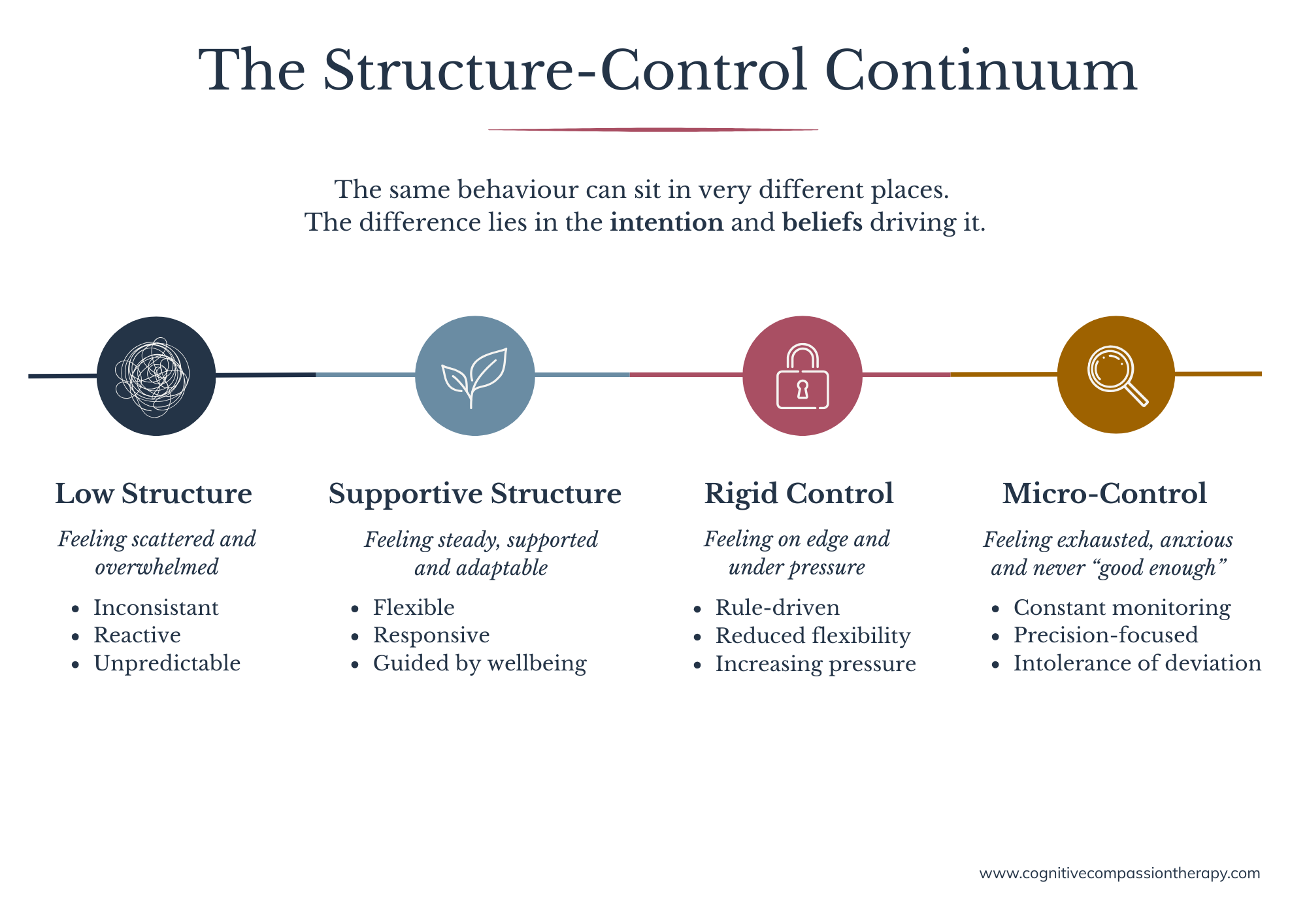
The Structure-Control Continuum
Rather than thinking about control as something you either “have” or “don’t have”, it is more accurate to think of it as a continuum.
At one end, there is very little structure:
things feel inconsistent, unpredictable, sometimes overwhelming.
At the other, there is a high degree of control:
tight rules, reduced flexibility, and a growing sense of pressure to maintain things precisely.
Most people move somewhere along this range, depending on what is happening in their lives.
In the middle is where structure tends to be most supportive, there is enough consistency to feel steady, but enough flexibility to adapt.
The difficulty arises when the system begins to drift further along not deliberately, but as a response to increased pressure.
Why the Mind Moves Toward Control
This movement along the continuum isn’t random. It’s learned.
When increasing structure helps things feel more manageable, the mind begins to associate more structure with more stability.
So when something feels difficult; low mood, stress, uncertainty, the natural response becomes: tighten things up.
Add more rules.
Be more precise.
Pay closer attention.
And initially, this often works.
There is a sense of relief. A feeling of being back “in control”.
This is closely linked to what I described in a previous article as the Control Paradox, where the very strategies used to feel more stable can, over time, begin to create the conditions that make things harder to sustain.
Because while increasing control can reduce discomfort in the short term, it also creates a system that depends on maintaining very specific conditions.
And those conditions are difficult to sustain in real life.
When Control Becomes Effortful
As behaviour moves further along the continuum, the experience of day-to-day life often begins to shift.
There is more checking.
More adjusting.
More anticipation of things slipping.
The system becomes increasingly effortful to maintain and gradually, something subtle but important happens;
You are no longer just living your life.
You are managing it.
This is often where anxiety begins to increase again. Not because there is too little control but because there is too much of the wrong kind.
Why This Can Make Change Feel Difficult
This distinction becomes particularly important in areas like eating patterns, body image, and perfectionism.
Because in these areas, structure is often part of the solution.
Regular eating.
Planning ahead.
Creating consistency.
These are important and often necessary steps.
But what can make change more complex is that the same behaviours that support recovery can also be used in a controlling way, depending on the intention behind them.
So someone might:
follow a structured eating pattern to support stability
but do so with a high level of rigidity, pressure, or self-criticism
Or:
introduce routines to reduce overwhelm
but feel unable to deviate from them without distress
This is where the continuum becomes particularly relevant because the work is not simply about what you are doing. It is also about how and why you are doing it.
Over time, part of the process is not just building structure but gradually shifting the intention behind that structure.
From: control, pressure, or self-correction
Towards: support, balance, and a more sustainable way of responding to yourself
How This Often Shows Up in Thinking
For many people, the first signs of this shift aren’t behavioural, they’re cognitive.
Thoughts become more absolute. More urgent.
“I need to keep this under control.”
“If I relax this, everything might slip.”
“I should be able to manage this better.”
“I need to get back on track.”
These thoughts often signal that the system is no longer just supportive.
It has become protective.
Where This Leaves You
For many people, recognising this shift is the point where things begin to make more sense. Not because it immediately changes behaviour,
but because it reframes what has been happening.
The aim isn’t to remove structure. Structure can be helpful.
But when it becomes rigid, pressure-driven, or tied too closely to feeling “okay”, it can start to limit rather than support.
Broadening that gently, and in a way that still feels steady is often where meaningful change begins.
And importantly, this isn’t about getting it “right”.
It’s about understanding how your system has adapted over time, including the role intention has played in shaping that.
Which means it can also be adjusted.
You might recognise parts of this across different areas of your life, eating, routines, work, or how you manage yourself more generally.
In earlier articles, I’ve explored how control can start as a way of creating stability, and how over time, it can become something we rely on more heavily than we realise.
What this continuum adds is a way of understanding where that shift sits, not as something fixed, but as something that can move depending on what’s happening around you, and within you.
Taken together, these patterns begin to form a clearer picture.
Not of something going wrong, but of a system that has been trying to keep things steady, sometimes in ways that eventually become harder to sustain.