

When Trying to Stay in Control Starts to Backfire
What begins as a way of staying steady can gradually turn into a system that is difficult to sustain.
Many people who struggle with eating patterns, emotional overwhelm, or persistent self-criticism are not lacking discipline.
In fact, the opposite is often true.
They plan carefully, hold themselves to high standards, and monitor themselves closely. They try to stay composed, consistent, and in control.
From the outside, this can look capable, organised, even admirable.
But internally, it often feels very different.
Over time, maintaining that level of control can become quietly exhausting. What once created stability begins, gradually, to generate pressure.
And this shift, often subtle at first, is where things start to change.
Control Often Begins as a Solution
Control rarely develops without reason.
In many cases, it begins as a way of managing something difficult, emotional vulnerability, uncertainty, self-doubt, or a fear of things slipping.
Bringing in structure can feel stabilising. Routines create order. Rules reduce decision-making. Standards provide direction.
At this stage, control is not the problem.
Structure can support wellbeing. Discipline can be helpful. Planning can reduce overwhelm.
But over time, something begins to shift.
When Control Starts Carrying More Than It Should
What often happens is that control stops being purely practical.
It starts to take on psychological weight.
It becomes tied, quietly but powerfully, to feeling safe, feeling “together,” feeling acceptable, and feeling in control of oneself.
And when that shift happens, small things no longer feel small.
A missed workout or an unplanned meal can start to feel disproportionate. A drop in productivity or an emotional reaction that breaks through composure can feel exposing.
Not just inconvenient but as though something more fundamental is starting to slip.
At that point, the reaction is rarely about the behaviour itself. It reflects the meaning that has become attached to staying in control.
And this shift usually happens gradually, without being consciously noticed.
Why Control Becomes So Compelling
From a cognitive behavioural perspective, control is reinforced because it works, at least in the short term.
When something feels uncertain or emotionally unsettled, increasing control often brings immediate relief. More structure. More clarity. A sense of containment.
The mind learns quickly from this.
Control begins to feel like safety.
And over time, certain assumptions start to organise behaviour:
“If I stay disciplined, I’m okay.”
“If I lose control, something is wrong with me.”
“Strength means holding everything together.”
These beliefs are not always explicit. But they shape patterns in powerful ways.
When Structure Becomes Rigid
The difficulty with control is not that it exists.
It’s that, over time, flexibility can quietly disappear.
Standards tighten. Monitoring increases. The margin for error narrows.
What once felt supportive starts to require constant effort to maintain.
And life inevitably doesn’t cooperate.
Stress, fatigue, emotional strain, hormonal shifts, and everyday unpredictability begin to place pressure on the system.
At this point, something important tends to happen.
The problem is often misread.
Instead of recognising that the system has become too rigid, the mind concludes:
“I need to be more controlled.”
And so the system tightens further.
The Control Paradox
Over time, this creates a pattern that can feel both frustrating and difficult to make sense of.
The very strategy used to stay stable begins to create instability.
This is the control paradox.
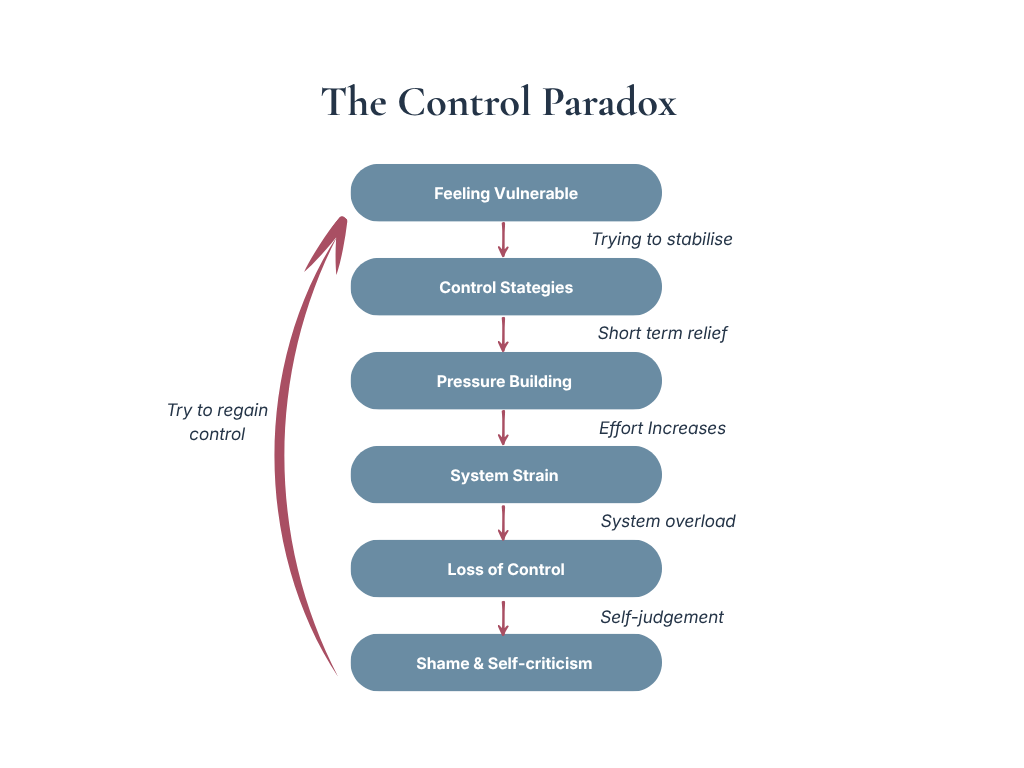
The more tightly control is held in place, the harder it becomes to sustain under real-life conditions.
Eventually, the system gives way.
Sometimes suddenly.
Sometimes in ways that feel completely at odds with how controlled things seemed just moments before.
It may show up as binge eating after periods of restriction, emotional overwhelm after holding everything together, or abandoning routines that have been maintained with precision.
When this happens, the response is often quick and instinctive.
Harsh self-criticism. Renewed pressure. A determination to “get back on track.”
And so the cycle restarts.
From the outside, this can look inconsistent.
Internally, it is often a highly organised system under strain.
Why “Losing Control” Isn’t Random
These rebound moments are often misunderstood.
They’re interpreted as a lack of discipline or a failure of willpower.
But psychologically, they tend to reflect the opposite.
They are the predictable outcome of a system that has become too rigid to hold.
When pressure builds for long enough, something has to give.
Not because the person is weak but because the system itself is unsustainable.
A Different Way of Understanding What’s Happening
One of the most important shifts is this:
The difficulty is often not a lack of control.
It’s too much control, held too tightly, for too long.
Seen in this way, behaviours that feel confusing or frustrating begin to make more sense.
Binge eating. Emotional overwhelm. Sudden disruption to routines.
These are not personal failures.
They are signals that a system built on rigid control has reached its limit.
For many people, understanding this brings a noticeable sense of relief.
Not because everything changes immediately but because the pattern finally makes sense.
If This Feels Familiar
If you recognise yourself in this pattern, it may help to understand that this isn’t simply about discipline or willpower.
It’s about the way control has become linked to safety, identity, and self-worth.
Therapy offers a space to understand this more clearly and to begin, gradually, building a way of living that no longer depends on holding everything together so tightly.