

The Gut-Brain Connection Is Real. But It Is Not a Wellness Short Cut.
Why nutrition matters for mental health, and why emotional wellbeing is more than biology.
It is fair to say that gut health is having a moment.
We are hearing more than ever about the microbiome and, perhaps more interestingly (well, I think so), the influence it may be having on mental health conversations.
Conversations that once sat almost entirely within psychology and psychiatry have increasingly moved into nutrition, lifestyle, inflammation, gut health and the microbiome. It is now common to see explanations for anxiety, low mood, fatigue and emotional difficulties framed through the language of healing the gut, reducing inflammation, balancing the microbiome, or optimising health from the inside out.
The emerging science around the gut–brain axis is genuinely fascinating (and admittedly an area I could happily geek out on all day), and it is clinically relevant. The idea that what happens in the digestive system could influence mood, cognition and emotional wellbeing represents an important shift away from viewing mental health as something that happens only “in the mind”.
At the same time, I think there is also something psychologically appealing about these narratives.
When I tell people that I am a CBT therapist and nutritional health coach, there is often immediate interest in the nutritional element. And I think I understand why.
Messages such as heal your gut, heal your mood offer something tangible and predictable. They give us a lever we can pull. We can change our food intake, buy supplements, follow protocols and feel as though we are actively doing something.
Now compare that with the uncertainty of emotional work, relationships, grief, self-criticism or long-standing psychological patterns. Nutritional interventions can feel considerably more concrete and manageable.
I know which route I tried first.
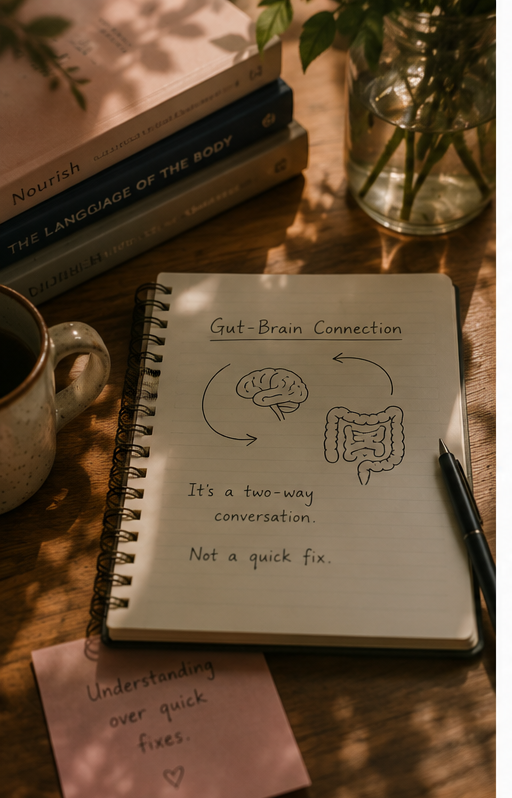
The difficulty is not that the gut–brain connection is wrong. It is that it is often presented as a much simpler story than it really is. The relationship between the gut and brain is not linear; it is reciprocal, and that distinction matters.
The Gut And Brain Are Not Separate Systems.
The gut and brain exist in constant communication through multiple pathways involving the nervous system, immune signalling, hormones, metabolites produced by gut bacteria and wider physiological systems involved in regulation and adaptation. Information is moving continuously between the two.
This communication network is broadly referred to as the gut–brain axis.
Within this system, the gut does considerably more than digest food. It contributes to immune function, influences inflammatory processes, interacts with stress systems and participates in wider regulation throughout the body. Changes occurring within the digestive system can influence mood, cognition, appetite, energy and emotional functioning.
At the same time, the relationship does not stop there.
Because the brain is also influencing the gut continuously, and this is often the part that receives less attention in public conversations.
One of the unintended consequences of social media health content is that the gut–brain relationship can sometimes become simplified into a one-way model: poor gut health leads to poor mental health.
It is an appealing explanation because it feels clear and actionable. Clinically though, it is incomplete.
Psychological experiences influence physiology just as physiology influences psychology.
The conversation becomes particularly interesting when we remember that the brain is not simply observing our experiences. It is responding to them, learning from them and adapting to them continuously.
And those adaptations have physiological consequences.
The Relationship Moves In Both Directions.
The brain’s primary role is survival.
From the moment we are born it begins learning about the world around us, forming assumptions, predictions and rules designed to help keep us safe. Many of these processes happen automatically and outside awareness, but they still influence how we think, behave and respond to difficulty.
When the brain senses threat it creates a biological response we know as stress. Periods of sustained stress do not remain neatly contained within thoughts or emotions. The body responds. Stress systems become more active, particularly pathways involved in threat detection, adaptation and regulation. Cortisol shifts, autonomic responses change and the body begins prioritising resources differently.
In that state, digestion can become less prioritised. Gut motility may alter and wider digestive functioning can shift as the body adapts to perceived demands. Emerging research also suggests chronic stress may alter microbiome diversity and composition in ways that can affect inflammation, mood and cognition.
The gut is not sitting on the sidelines observing the psychological experience. It is participating in it, adapting to it.
I think this becomes particularly relevant in the kinds of experiences I often see clinically: periods of chronic self-pressure, persistent self-monitoring, trying very hard to hold everything together, and living with high internal standards alongside very little permission to soften
From the outside these experiences may appear primarily emotional or cognitive. Physiologically however, the system may be carrying a sustained level of threat activation for prolonged periods of time.
The woman replaying conversations at 2am, mentally reviewing whether she said the wrong thing, may also be the woman struggling with digestive symptoms.
The systems are not separate and this is perhaps where the gut–brain conversation starts becoming more nuanced.
When Nutrition Meets Psychology.
Recognising this bidirectional relationship is not an argument against nutrition.
Quite the opposite actually. Nutrition is finally being recognised as a fundamental pillar of health and, frankly, it is about time.
Food influences energy availability, blood glucose regulation, cognition, inflammatory processes, hormonal functioning and wider physiological stability. Regular nourishment can support concentration, behavioural consistency, emotional resilience and overall functioning.
The relationship between nutrition and mental health is therefore both real and important.
At the same time, one of the things I have noticed working across therapy and nutrition is how rarely food enters people’s lives as a purely physiological experience.
Food arrives within an existing psychological context.
And for many women, that context already contains years of learning around self-worth, achievement, appearance, pressure, responsibility and what it means to be “doing well”. We live within a culture that repeatedly asks women to optimise themselves. To improve, self-monitoring, reduce, fix and perform wellness correctly. Perhaps this is partly why gut health narratives resonate so strongly.
Psychologically, they offer something understandable and appealing. They give us something tangible to do. We can change our breakfast, take the supplements, follow protocols, improve the microbiome and feel as though progress is happening. And to be clear, sometimes it is.
But emotional work often asks for something less concrete. It may ask us to sit with uncertainty, loosen old rules, question long-standing beliefs, process loss, develop self-compassion or recognise patterns we have carried for years.
That work is considerably harder to package into a morning routine and a supplement.
Given the choice between changing breakfast or unpacking self-criticism, I suspect most of us would choose the breakfast first. I know I did.
The difficulty is simply that some experiences sit outside the reach of nutrition.
Food cannot process grief, a probiotic cannot soften self-criticism. Microbiome support cannot rewrite protective patterns the brain learned in order to survive difficult experiences. And this is where I think psychologically informed nutritional work becomes important.
Because the question is not only what nutritional intervention are we introducing?
It is also: What role is this intervention beginning to play?
Is it supporting health or is it becoming another pressure point. Is it something that we are using to seek reassurance, certainty or another place where self-worth gets measured?
The same nutritional strategy can function very differently depending on the psychological environment it enters. Externally the behaviours may look identical, but internally they may be serving entirely different purposes.
And that difference is meaningful.
A Wider View Of Mental Health.
Perhaps this is where the growing interest in the gut–brain connection becomes genuinely valuable. Not because it provides a new explanation for everything, but because it encourages a broader understanding of health.
Mental wellbeing does not occur independently from physiology. Sleep influences emotional regulation and hormonal shifts influence mood and cognition. Nutrition affects energy, concentration and coping capacity. Stress influences both psychological and physiological functioning simultaneously.
The difficulty is that, within wellness culture, complex experiences can sometimes become simplified into messages that imply mental health can be fixed through food, supplements, gut healing or lifestyle optimisation alone.
For some people, lifestyle changes and nutritional support may be enough. Sometimes people simply need information, structure, encouragement or accountability to help them move towards healthier behaviours.
But some experiences sit at a different depth.
When someone is living with persistent self-criticism, deeply held beliefs about themselves, protective patterns developed over many years, unresolved experiences or psychological distress that is affecting daily functioning, change often requires something else alongside information.
It requires psychological safety.
Because meaningful change is not always about adding another protocol, habit tracker or self-monitoring task. Sometimes it is about understanding the patterns that developed, why they made sense, and creating enough safety to begin changing them.
Nutrition has an important place within that work. It supports physiology and it supports stability. But gut health alone was never designed to carry the full weight of emotional wellbeing.
If we reduce mental health entirely to biology, we risk missing the unique person sitting underneath it.